Rajasthan LDC 2026: Expected Cut-Off, Typing Test & Efficiency Test — The Complete Guide
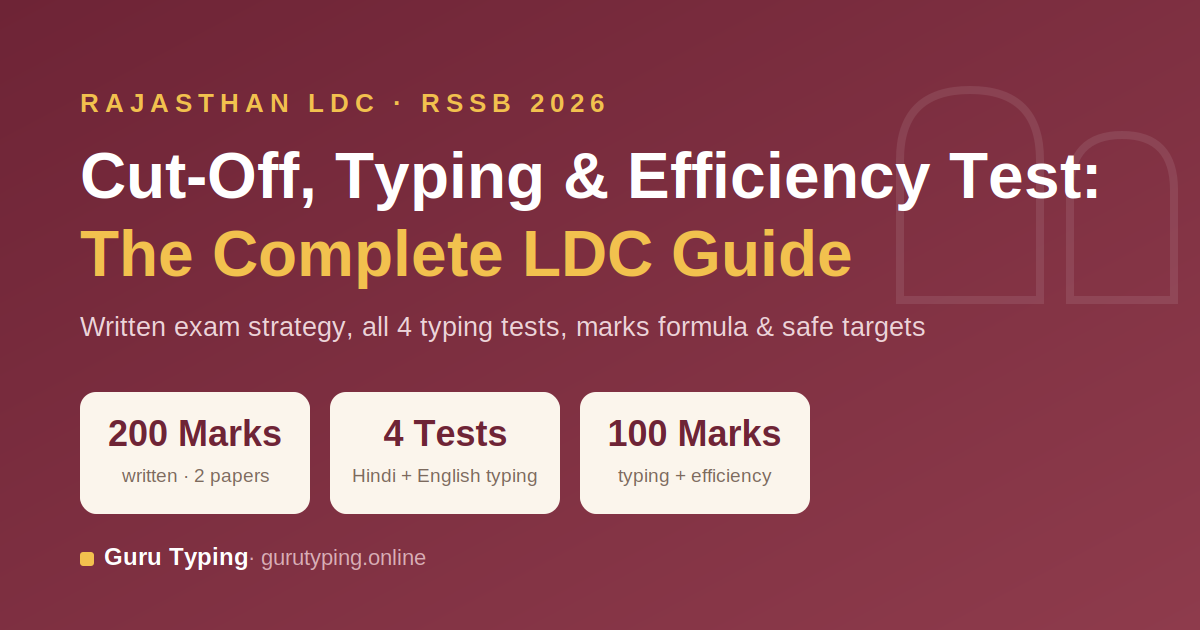
With the Rajasthan LDC 2026 written exam (held on 5–6 July for a massive 10,644 vacancies) now behind us, lakhs of aspirants are asking two questions: "What will the cut-off be?" and "How do I prepare for the typing test?" And here's the fact that separates the selected from the rest — Rajasthan LDC is one of the very few government exams where the typing stage carries a full 100 marks and where typing in both Hindi AND English is compulsory. Your keyboard doesn't just qualify you here; it directly decides your rank in the merit list.
In this guide from Guru Typing, we break down the complete picture: the exam structure, realistic cut-off analysis, all four typing and efficiency tests with the exact marks formula, safe word-count targets, and a preparation strategy for both the written exam and the skill test.
Rajasthan LDC Selection Process at a Glance
The recruitment for Junior Assistant and Clerk Grade-II (LDC) runs in two phases, followed by document verification:
| Stage | Details | Marks |
|---|---|---|
| Phase 1 — Paper I | General Knowledge (Rajasthan-focused), Everyday Science, Mathematics · 150 questions · 3 hours | 100 |
| Phase 1 — Paper II | General Hindi & General English · 150 questions · 3 hours | 100 |
| Phase 2 — Typing & Efficiency Test | 4 tests: speed + efficiency in Hindi and English · 10 minutes each | 100 |
Negative marking alert: Every wrong answer in the written exam costs you 1/3 (0.33) marks. With cut-offs decided by decimals in a 10,000+ vacancy race, reckless guessing on 20–30 questions can quietly push you below the line.
Rajasthan LDC Cut-Off: Qualifying Marks vs the Real Cut-Off
First, the officially fixed minimum qualifying marks — the bare minimum to stay in the race:
| Stage | Category | Minimum Qualifying |
|---|---|---|
| Written exam (Phase 1) | General / OBC / EWS | 40% (80 out of 200) |
| Written exam (Phase 1) | SC / ST | 35% (70 out of 200) |
| Typing & efficiency test (Phase 2) | All categories | 36% in each test (9 out of 25) |
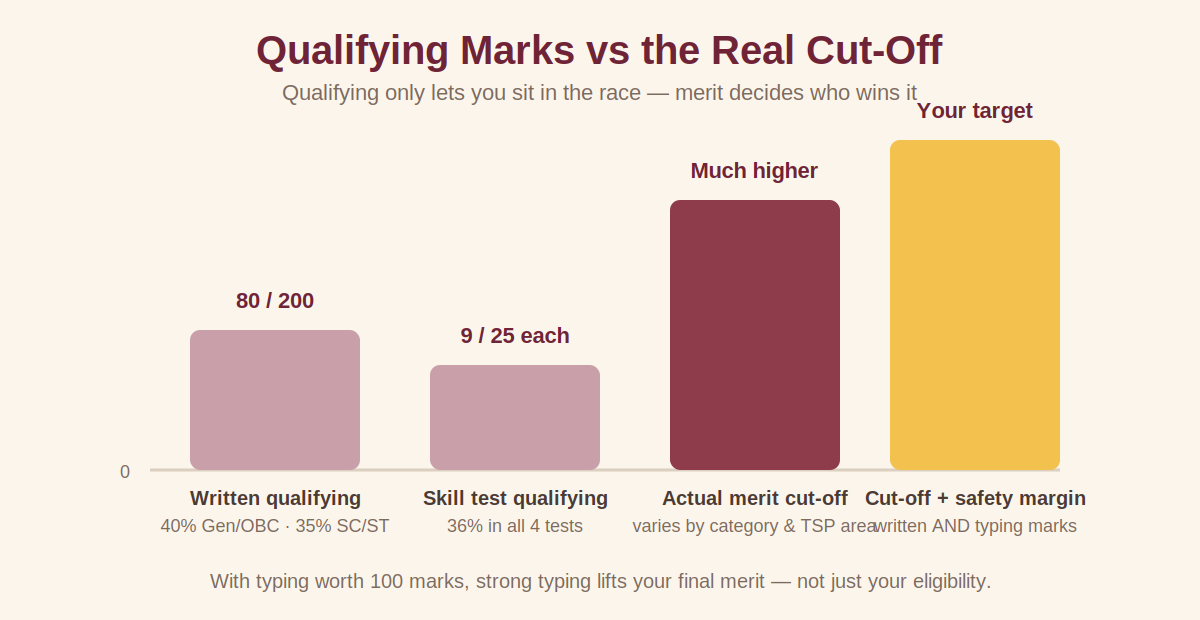
Now the honest truth about the expected cut-off: the actual selection cut-off is always far above these qualifying marks, and it's declared category-wise and separately for TSP and Non-TSP areas of Rajasthan. It depends on three things — the paper's difficulty level, the number of vacancies, and how the top lakh candidates performed. The 2026 cycle has two opposing forces at play: the huge vacancy count (10,644) pulls the cut-off down, while the record number of applicants pushes it up.
What this means practically: don't build your strategy around scraping past a predicted number. Build it around a safety margin — aim to score comfortably above the previous cycle's category cut-off in the written exam, and then remember that the typing test's 100 marks are added to your merit. Two candidates with identical written scores can finish 20 marks apart in the final list purely on typing. That's the lever most aspirants ignore, and it's entirely in your control.
Phase 2: The Typing & Efficiency Test Explained
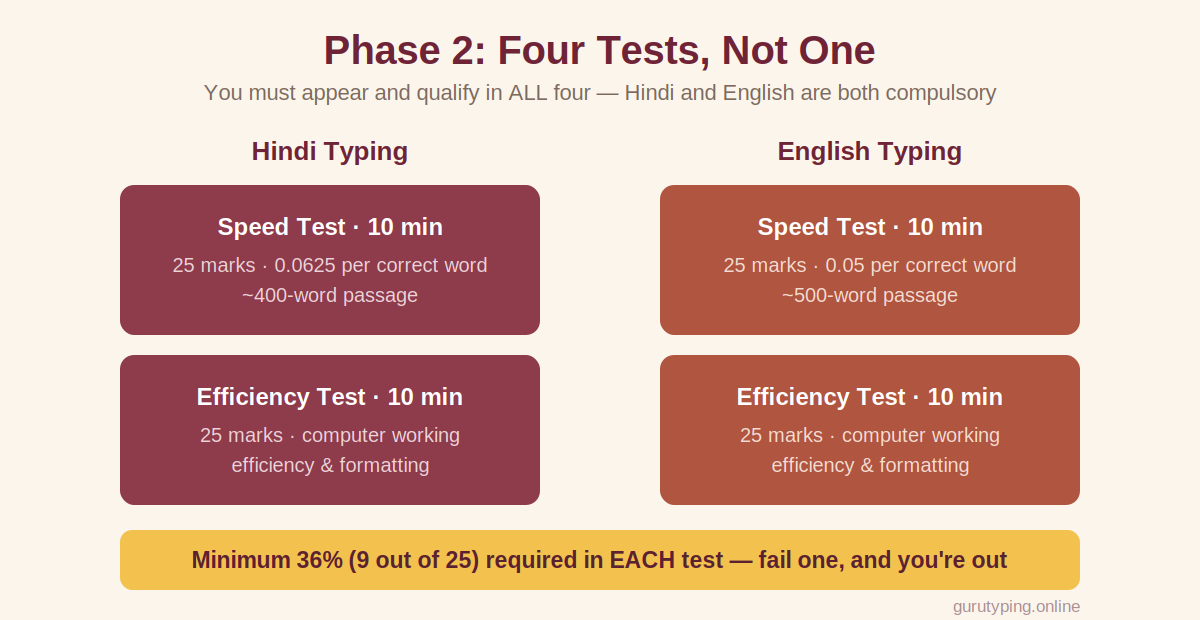
This is where Rajasthan LDC differs from almost every other clerk exam in India. You don't choose a language — you face four separate tests, and you must appear and qualify in all of them:
The speed tests (Hindi + English)
In each speed test you type a given passage on the computer for 10 minutes — roughly a 500-word passage in English and a 400-word passage in Hindi. Marking is word-based and beautifully simple:
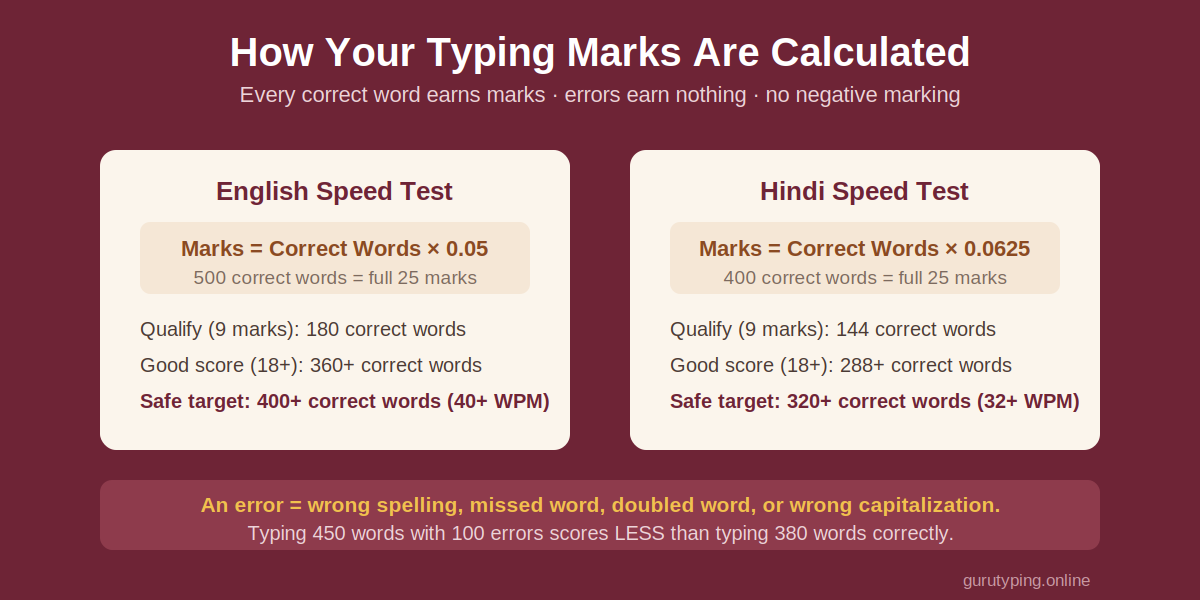
- English: 0.05 marks per correct word → 180 correct words to qualify (9 marks), 500 for full marks
- Hindi: 0.0625 marks per correct word → 144 correct words to qualify (9 marks), 400 for full marks
- Errors earn zero — a missed word, doubled word, wrong spelling, or wrong capitalization is counted as an error. There's no negative marking, but every error is a word's worth of marks thrown away.
Do the maths that toppers do: qualifying needs only 18 WPM in English — almost anyone can pass. But full marks need 50 WPM. Between "pass" and "perfect" lie 16 merit-deciding marks per language. A candidate typing 40 WPM in English and 32 WPM in Hindi picks up roughly 15–20 more merit marks than one who merely qualifies. In a race where written cut-offs are separated by decimals, this is the single biggest score jump available anywhere in the exam.
The efficiency tests (Hindi + English)
The second component in each language is the efficiency test — 10 minutes, 25 marks — which checks your practical working ability on the computer: producing the given matter accurately in the required format and layout. Two rules of thumb: first, read the given handout completely before touching the keyboard, because marks are tied to matching the required output, not just typing fast. Second, practise basic document formatting (alignment, spacing, capitalization, paragraph structure) until it's automatic — the 10-minute window punishes anyone who has to think about where a formatting option is. The exact instructions are provided at the centre, so train your fundamentals rather than memorising one format.
Full Preparation Strategy: Written + Typing Together
Written exam (for upcoming cycles and re-attempters)
- Rajasthan GK is the deciding subject. History, geography, art & culture, and polity of Rajasthan dominate Paper I — this is where local, focused preparation beats generic SSC-style study.
- Paper II is a gift for typing aspirants: the same Hindi and English grammar you master for the written paper directly reduces your typing errors later. Prepare them as one skill, not two subjects.
- Respect the 0.33 negative marking: attempt a question only when you can eliminate at least two options. Practise previous year papers with a timer to build this discipline.
Typing & efficiency test (start today, not after the result)
- Days 1–20 — Touch typing in BOTH languages. Home row discipline, all ten fingers, zero looking at the keyboard. Since Hindi typing is compulsory, learn the Hindi keyboard layout properly at gurutyping.online — most failures in Phase 2 come from the Hindi test, because aspirants postpone it.
- Days 21–45 — Alternate-day language cycling. Hindi on odd days, English on even days, 45–60 minutes daily. Take a timed 10-minute test at the end of every session and log your correct-word count — that number, not WPM alone, is your actual score in this exam.
- Days 46–60 — Full exam simulation. All four tests back-to-back, exactly like exam day: 10-minute English speed, 10-minute Hindi speed, plus formatting practice for both efficiency tests. Safe targets before the real exam: 400+ correct English words and 320+ correct Hindi words per 10-minute test.
5 Mistakes That Cost Rajasthan LDC Aspirants Their Selection
- Treating typing as "just qualifying." It's 100 marks of your merit. The topper mindset is to maximise it, not survive it.
- Preparing only English typing. Both languages are compulsory, and the Hindi test eliminates more candidates than the English one every cycle.
- Chasing raw speed over correct words. Marks come only from correct words — 450 words with 100 errors scores less than 380 clean words.
- Starting typing after the written result. The gap between result and skill test is rarely enough to build two-language muscle memory from zero.
- Ignoring the efficiency tests. They're worth exactly as much as the speed tests — 50 of the 100 marks — yet get a fraction of the practice time.
Turn the Typing Test Into Your Merit Booster — with Guru Typing
Rajasthan LDC rewards exactly one thing in Phase 2: correct words, in both languages, under a 10-minute clock. That's precisely what Guru Typing trains:
- Hindi and English typing practice matched to the RSSB LDC exam pattern
- Full 10-minute timed tests with correct-word count and marks calculated by the LDC formula
- Exam-style passages so practice feels exactly like the real test
- Error analysis showing which words and keys cost you marks
One hour a day, both languages, sixty days — and Phase 2 stops being a hurdle and becomes your rank-lifter. Start now at gurutyping.online.
Frequently Asked Questions (FAQ)
- Q1. How many marks is the Rajasthan LDC typing test?
- Phase 2 carries 100 marks in total — four tests of 25 marks each: a speed test and an efficiency test in Hindi, and a speed test and an efficiency test in English. Each test is 10 minutes.
- Q2. What is the qualifying mark for the typing test?
- 36% in each test — at least 9 out of 25 marks in every one of the four tests. Failing even one test means disqualification.
- Q3. How are the typing marks calculated?
- Each correctly typed word earns marks: 0.05 per correct English word and 0.0625 per correct Hindi word. Errors (wrong spelling, missed/doubled words, wrong capitalization) earn nothing, but there's no negative marking.
- Q4. What are the minimum qualifying marks in the written exam?
- 40% for General/OBC/EWS and 35% for SC/ST. Only candidates clearing this are called for Phase 2 — but the actual merit cut-off is always much higher than the qualifying marks.
- Q5. Is typing compulsory in both Hindi and English?
- Yes. Unlike most typing exams where you pick one language, Rajasthan LDC requires you to appear and qualify in both Hindi and English tests.
- Q6. What will the Rajasthan LDC 2026 cut-off be?
- The official cut-off is released with the result, category-wise and separately for TSP/Non-TSP areas. It depends on paper difficulty, the 10,644 vacancies, and overall performance — and it's always well above the qualifying marks, so target a comfortable safety margin plus strong typing marks.
Disclaimer: Details are based on recent RSSB/RSMSSB notifications and previous recruitment cycles. Patterns, marks and rules can change between cycles — always verify against the official notification at rssb.rajasthan.gov.in.