BSF HCM & ASI Exam 2026: One Complete Strategy to Crack the Written Exam AND the Typing/Shorthand Test
Here's a truth most BSF aspirants learn too late: the written exam gets you shortlisted, but the skill test gets you selected. Every recruitment cycle, candidates who scored brilliantly in the CBT walk out of the skill test centre with nothing — because they spent eleven months on General Intelligence and eleven days on typing.
The BSF Head Constable (Ministerial) and ASI (Stenographer) recruitment is unusual among government exams because it demands two completely different kinds of preparation at the same time: knowledge preparation for the CBT and muscle-memory preparation for the typing or shorthand test. You cannot cram muscle memory. That's why this guide from Guru Typing gives you a single, parallel strategy that covers both — the full exam pattern, subject-wise CBT plan, skill test requirements, and a 90-day roadmap you can start today.
BSF HCM & ASI Selection Process: Know Every Stage
The recruitment happens in three phases, and every stage is mandatory:
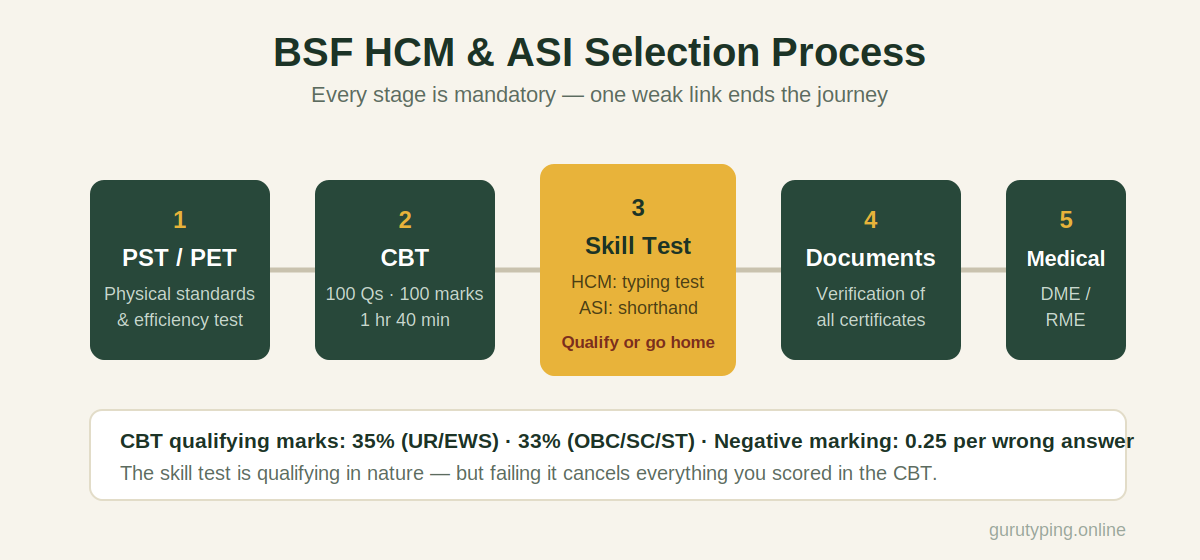
- Phase 1 — PST & PET: Physical Standards Test (height, chest for males) and Physical Efficiency Test. Stay fit throughout your preparation; don't leave running practice for the last month.
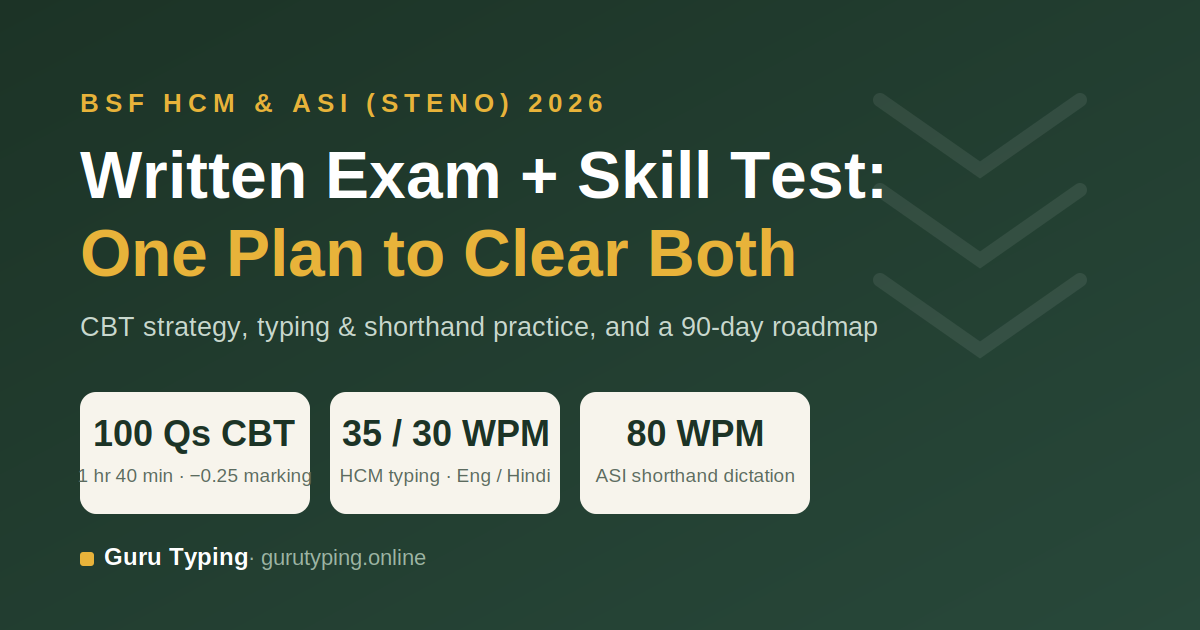
- Phase 2 — CBT (Written Exam): 100 objective questions, 100 marks, 1 hour 40 minutes, with 0.25 negative marking per wrong answer. Minimum qualifying marks: 35% for UR/EWS and 33% for OBC/SC/ST — but remember, qualifying marks only make you eligible; the merit cutoff is always much higher.
- Phase 3 — Skill Test + DV + Medical: Typing test for HCM, shorthand test for ASI, followed by document verification and detailed medical examination.
The trap hidden in "qualifying nature": The BSF skill test carries no marks — it's pass or fail. Many aspirants read this and relax. Read it the other way: your 85/100 in the CBT becomes zero the moment you type at 33 WPM instead of 35. The skill test can't add to your merit, but it can erase all of it.
The Written Exam (CBT): Section-Wise Strategy
The CBT has five sections of 20 questions each. Here's how to attack each one:
| Section | Questions | How to Prepare |
|---|---|---|
| Hindi / English Language (your choice) | 20 | Grammar rules, vocabulary, error spotting, idioms. Pick the language you're strongest in — same language logic as your typing choice. |
| General Intelligence (Reasoning) | 20 | Series, analogies, coding-decoding, syllogisms. Practice-heavy section — 20 questions daily beats theory reading. |
| Numerical Aptitude | 20 | Intermediate-level maths: percentages, ratio, time & work, averages. Learn shortcut methods; speed matters in a 100-minute paper. |
| Clerical Aptitude | 20 | The most neglected and most scoring section — alphabetical ordering, data checking, spotting differences. Pure practice; almost free marks for those who prepare it. |
| Basic Computer Knowledge | 20 | MS Office, internet basics, shortcuts, hardware fundamentals. Short syllabus, high return — finish it early and revise weekly. |
CBT tactics that actually move your score
- Respect the negative marking. With −0.25 per wrong answer, blind guessing on 20 questions can wipe out 5 earned marks. Attempt only when you can eliminate at least two options.
- Clerical Aptitude is your secret weapon. Most aspirants come from SSC-style preparation and have never practised clerical questions. Fifteen days of focused practice here can put you 10 marks ahead of the crowd.
- Solve previous year papers in exam conditions. 100 questions in 100 minutes means one minute per question — train your internal clock, not just your knowledge.
The Skill Test: What HCM and ASI Each Demand
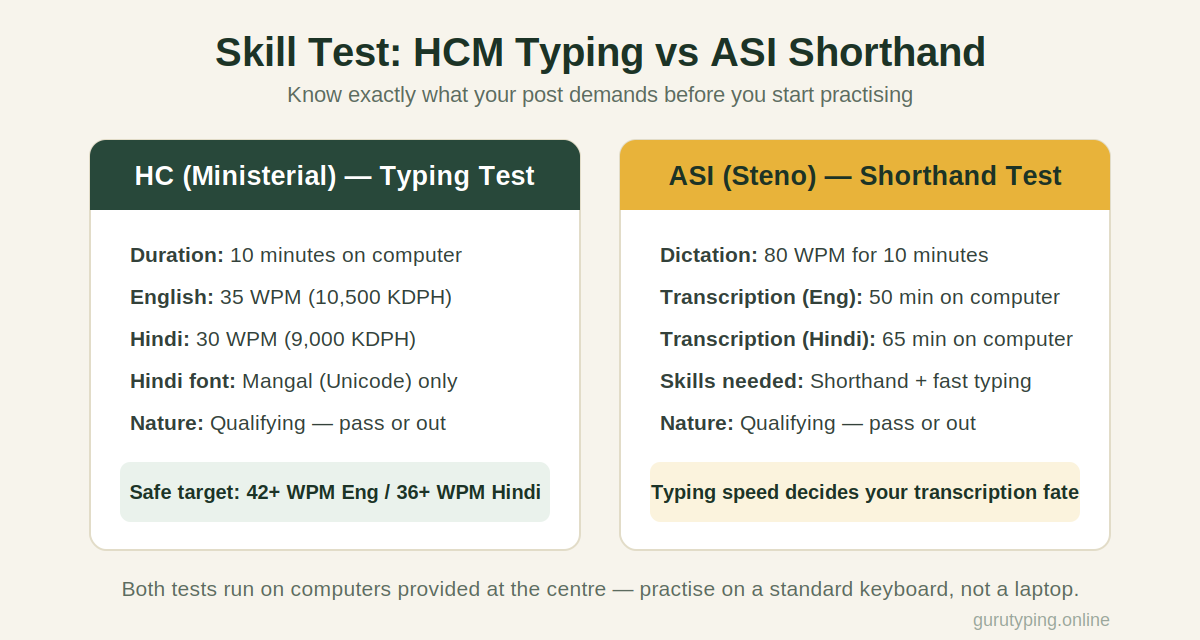
For HC (Ministerial): the typing test
You'll type a passage on a computer for 10 minutes. The minimum speed is 35 WPM in English (10,500 key depressions per hour) or 30 WPM in Hindi (9,000 KDPH). Note that this is higher than many other government typing tests — Delhi Police HCM, for example, asks only 30 WPM in English. If you're preparing for multiple exams, train for the BSF standard and every other test becomes easy.
Two details that eliminate unprepared candidates every year:
- Hindi typing is conducted in Mangal (Unicode) font only. If you've been practising in Krutidev for other exams, the key layout is different — switch your practice to Mangal well in advance, because relearning a layout two weeks before the exam is a recipe for disaster.
- The computer and keyboard are provided at the centre. Practise on a standard external keyboard, not your laptop — laptop keys have shallower travel and your speed will drop 3–5 WPM on an unfamiliar full-size keyboard.
For ASI (Stenographer): the shorthand test
You'll take dictation at 80 words per minute for 10 minutes, then transcribe it on a computer within 50 minutes (English) or 65 minutes (Hindi). This is really two skills chained together: shorthand writing and fast, accurate typing. Aspirants often master the dictation but lose the test in transcription because their typing is slow — 800 words in 50 minutes demands a comfortable, error-free typing rhythm on top of readable shorthand notes.
The 90-Day Dual Preparation Strategy
The core principle: never prepare sequentially. "CBT first, typing after shortlisting" fails because there's usually not enough time between the CBT result and the skill test to build muscle memory from scratch. Run two tracks in parallel from day one — roughly 3 hours daily for the CBT and 1 focused hour for the skill test.
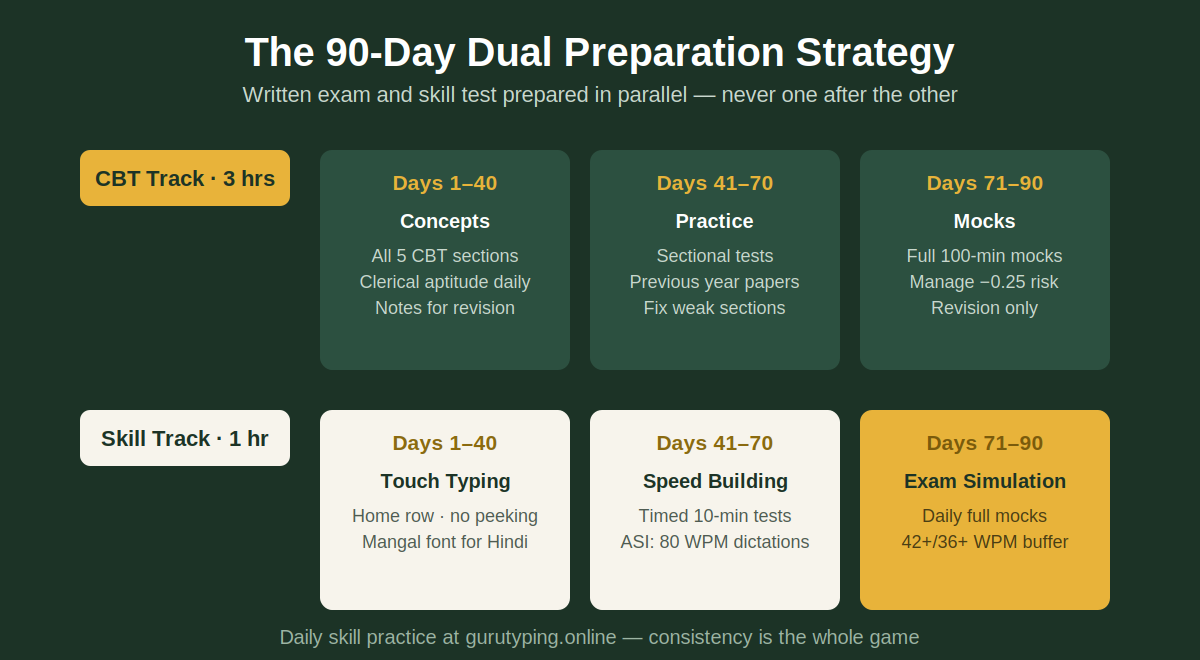
Days 1–40: Foundations on both tracks
- CBT track: Cover concepts of all five sections. Give Clerical Aptitude and Computer Knowledge 30 minutes daily each — short syllabus, high payoff. Make one-page revision notes per topic.
- Skill track: Learn touch typing properly — home row (ASDF–JKL;), all ten fingers, zero looking at the keyboard. Hindi candidates start directly on the Mangal layout at gurutyping.online. ASI aspirants begin daily shorthand outlines alongside typing. Accuracy target: 97%+. Ignore speed completely this month.
Days 41–70: Practice and speed
- CBT track: Sectional tests daily, previous year papers twice a week. Track your accuracy per section and give extra time to your weakest one.
- Skill track: Timed 10-minute typing tests on Guru Typing — HCM aspirants push toward 35/30 WPM with under 5 errors. ASI aspirants take 80 WPM dictations (start at 60 and build up) and transcribe them fully, on a timer.
Days 71–90: Full simulation
- CBT track: One full 100-minute mock daily under exam conditions. Practise your attempt order and your "skip or attempt" discipline against negative marking. Final week: revision notes only, nothing new.
- Skill track: Daily full-length skill tests in exam conditions — printed passage, external keyboard, 10-minute timer, no restarts. Build a safety buffer: 42+ WPM English or 36+ WPM Hindi, so exam-day nerves still leave you comfortably above the line. ASI aspirants do one complete dictation-plus-transcription cycle daily.
7 Mistakes That Eliminate BSF Aspirants Every Year
- Starting typing practice after the CBT result. Muscle memory needs 8–12 weeks minimum. Start on day one.
- Practising Hindi typing in Krutidev. BSF uses Mangal font. Verify your practice layout today.
- Ignoring Clerical Aptitude because it looks easy — then losing 8–10 marks to candidates who drilled it.
- Guessing freely in the CBT and letting −0.25 marking quietly eat a merit-deciding chunk of the score.
- Practising typing only on a laptop and losing speed on the centre's full-size keyboard.
- Training only to the minimum speed. 35 WPM in practice becomes 31 WPM under pressure. Build the buffer.
- Neglecting physical fitness until the end — PST/PET comes first in the process, not last.
Prepare Both Skills the Smart Way — with Guru Typing
The written exam has a hundred books. The skill test has one requirement: daily practice in real exam conditions. That's exactly what Guru Typing is built for:
- English and Hindi Mangal font typing practice matched to BSF exam patterns
- Full 10-minute timed tests with net WPM, KDPH, and accuracy calculation
- Printable passages for realistic paper-to-screen practice
- Error analysis that shows exactly which keys and words are slowing you down
One focused hour a day for 90 days — that's the entire distance between you and the skill test certificate. Start today at gurutyping.online.
Frequently Asked Questions (FAQ)
- Q1. What is the typing speed required for BSF HCM?
- 35 WPM in English (10,500 key depressions per hour) or 30 WPM in Hindi (9,000 KDPH), typed within 10 minutes on a computer provided at the centre.
- Q2. What is the shorthand requirement for BSF ASI (Steno)?
- Dictation at 80 words per minute for 10 minutes, followed by transcription on computer within 50 minutes for English or 65 minutes for Hindi.
- Q3. Which Hindi font is used in the BSF typing test?
- Mangal (Unicode) font, as per the BSF notification. If you've practised Krutidev for other exams, switch your practice layout to Mangal early.
- Q4. Does the BSF skill test carry marks?
- No — it is qualifying in nature. But failing it eliminates you completely, no matter how high your CBT score is.
- Q5. What is the BSF HCM/ASI written exam pattern?
- 100 objective questions, 100 marks, 1 hour 40 minutes, five sections of 20 questions each (Language, General Intelligence, Numerical Aptitude, Clerical Aptitude, Computer Knowledge), with 0.25 negative marking. Qualifying marks: 35% UR/EWS, 33% OBC/SC/ST.
- Q6. Should I prepare the written exam first and typing later?
- No. Typing and shorthand are muscle-memory skills that can't be crammed. Run both tracks in parallel from day one — about 3 hours daily for CBT and 1 hour for skill practice.
Disclaimer: Exam pattern details are based on recent BSF/CAPF notifications. Requirements can change between recruitment cycles — always verify against the official notification at rectt.bsf.gov.in before your exam.