How to Crack the Delhi Police HCM Typing Test in 2026 (Complete Guide + Practice Plan)
You worked hard for months, cleared the CBT, pushed through the physical test — and now everything comes down to 10 minutes on a keyboard. That's the reality of the Delhi Police Head Constable (Ministerial) recruitment. Every year, thousands of candidates who scored well in the written exam get eliminated at the typing stage, simply because they treated typing as an afterthought.
The good news? The typing test is the most predictable stage of the entire selection process. There are no surprise questions and no negative marking tricks. If you know the pattern and practise the right way, you can walk into the exam hall knowing exactly what your result will be. In this guide, we at Guru Typing break down everything — the pattern, the marking scheme, common mistakes, and a practical 60-day preparation plan.
Delhi Police HCM Typing Test Pattern at a Glance
| Detail | English Typing | Hindi Typing |
|---|---|---|
| Duration | 10 minutes | 10 minutes |
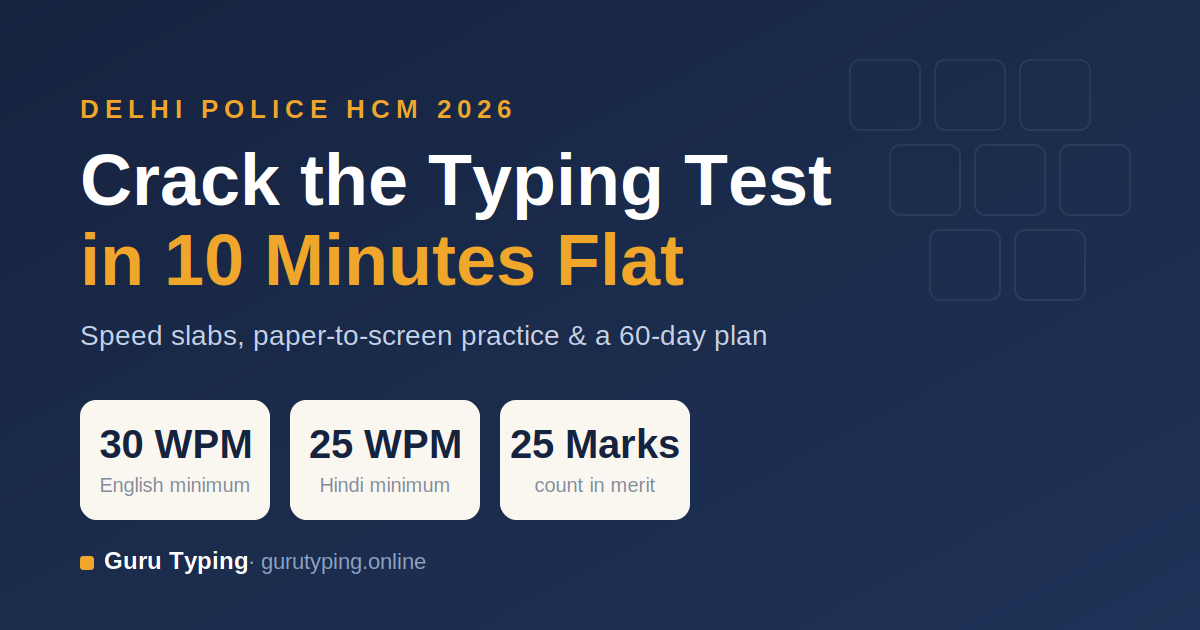
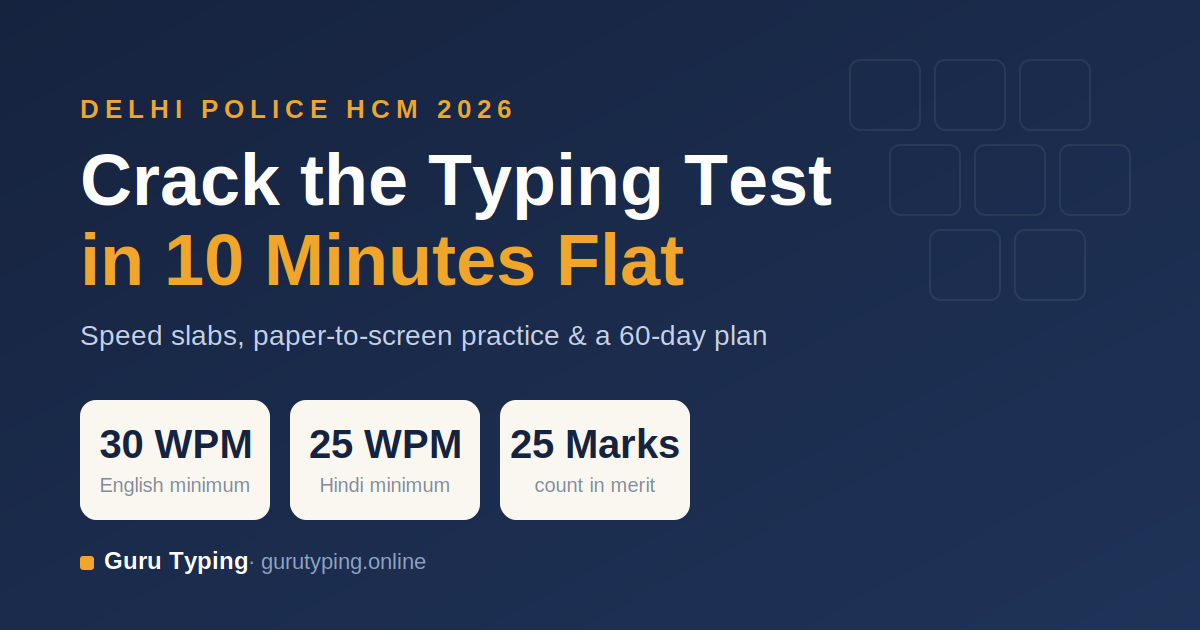
| Minimum qualifying speed | 30 WPM | 25 WPM |
| Passage length | Approx. 500 words / 2500 key strokes | Approx. 450 words / 1850 key strokes |
| Maximum marks | 25 | 25 |
| Below minimum speed | Disqualified | Disqualified |
A few important things to note:
- You choose your typing language (English or Hindi) while filling the application form, and you cannot change it later. Choose the language you're genuinely faster in, not the one that "sounds" easier.
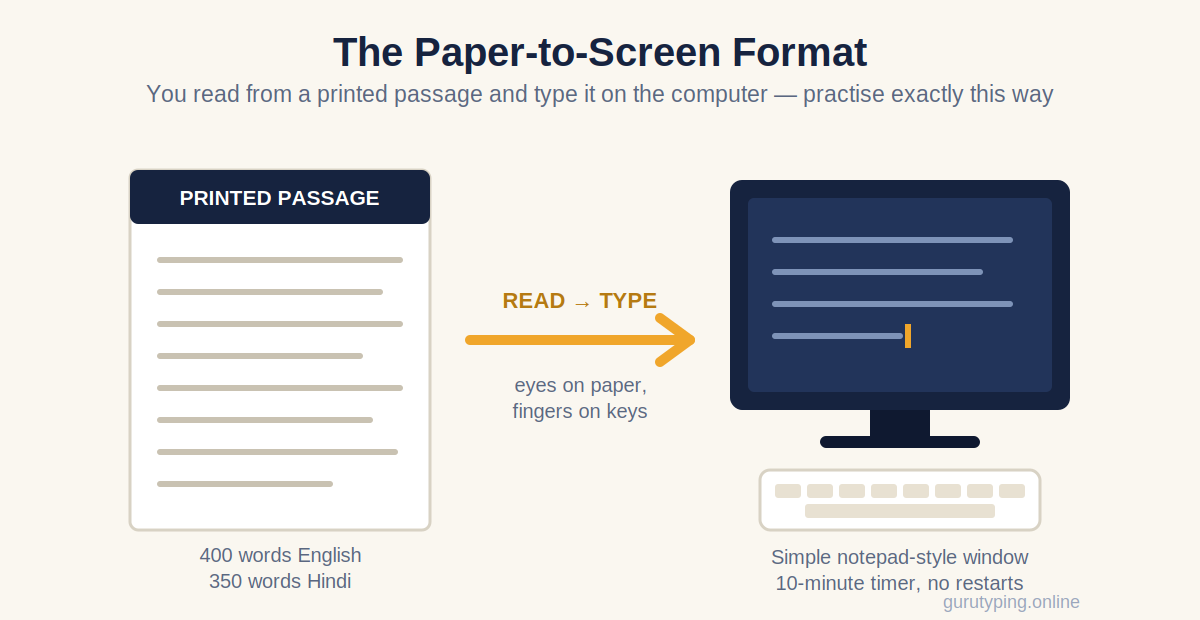
- The test is paper-to-screen: you're given a printed passage and must type it on the computer. This is harder than copying from the screen, and it's where most unprepared candidates lose speed.
- Hindi typing is generally conducted in the Krutidev font layout, which is quite different from typing Hindi on your phone. If you choose Hindi, practise specifically on Krutidev.
The Marking Scheme: Why 30 WPM Is Not Your Target
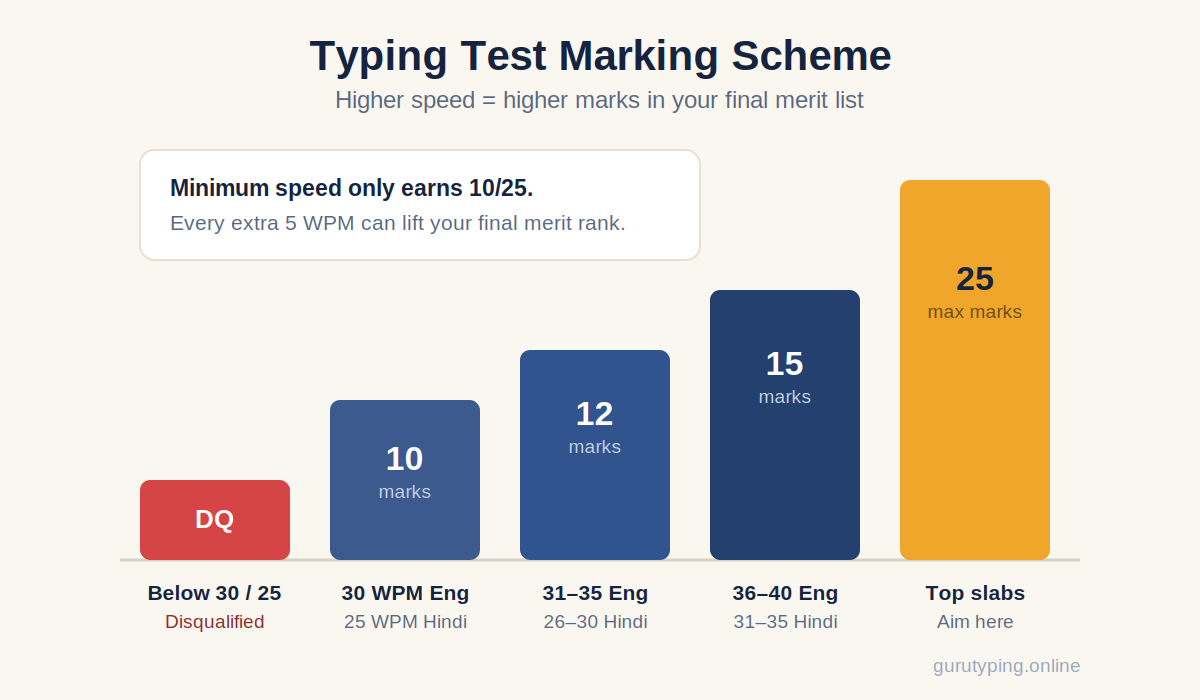
Here's what many candidates miss — the typing test isn't just qualifying in nature. The marks count toward your final merit. Clearing the minimum speed gets you only 10 out of 25 marks, while higher speeds earn progressively more:
| English Speed | Hindi Speed | Marks |
|---|---|---|
| Below 30 WPM | Below 25 WPM | Disqualified |
| 30 WPM | 25 WPM | 10 |
| 31–35 WPM | 26–30 WPM | 12 |
| 36–40 WPM | 31–35 WPM | 15 |
| Higher slabs | Higher slabs | Up to 25 |
Think about that. The difference between a candidate typing at 30 WPM and one typing at 45+ WPM can be 10–15 marks in the final merit list — often the difference between selection and the waiting list. So your real target should be at least 10 WPM above the minimum, with 95%+ accuracy.
Why Candidates Fail (Even After Practising Daily)
Most failures in the Delhi Police HCM typing test come from four mistakes:
1. Practising screen-to-screen only. Reading from a monitor and typing is a completely different skill from reading a printed page and typing. In the actual exam, your eyes constantly shift between paper and screen, lines get skipped, and rhythm breaks. If you've never practised paper-to-screen, expect your speed to drop by 20–30% on exam day.
2. Chasing speed before accuracy. Errors reduce your net speed, and net speed is what decides your marks. A candidate typing 45 WPM with 15 errors often scores lower than one typing 38 WPM with 3 errors. Accuracy first, speed second — always.
3. Looking at the keyboard. If your eyes go to the keyboard, they can't be on the printed passage. Touch typing (typing without looking) is non-negotiable for paper-to-screen tests. It feels slow for the first two weeks, then your speed explodes.
4. Practising in short bursts only. Typing for 2 minutes is easy. Holding speed and accuracy for a full 10 minutes under pressure is a different game — your fingers tire, your concentration dips around minute 6–7. You must regularly practise full-length 10-minute tests.
Your 60-Day Preparation Plan
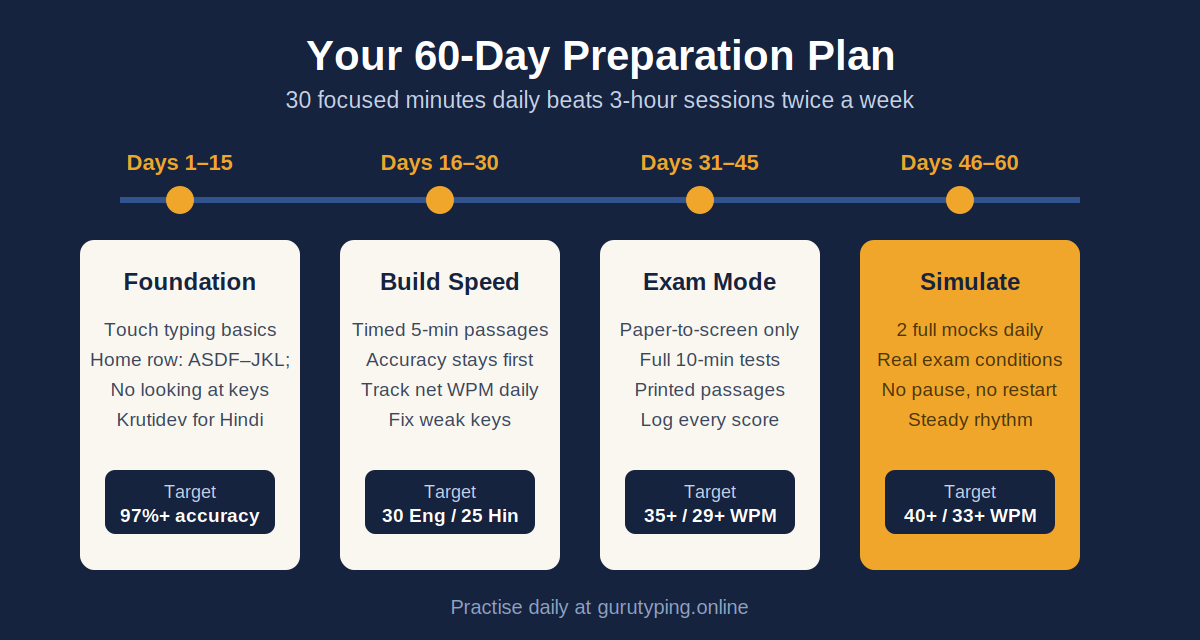
Days 1–15: Build the foundation. Learn correct finger placement (home row: ASDF–JKL;). Type slowly without looking at the keyboard. Speed doesn't matter yet — muscle memory does. Practise 45–60 minutes daily on Guru Typing, focusing on accuracy above 97%.
Days 16–30: Build speed with accuracy. Start timed 5-minute passages. Target: minimum qualifying speed (30 WPM English / 25 WPM Hindi) with under 5 errors. Hindi-medium candidates should now be fully comfortable with the Krutidev layout.
Days 31–45: Switch to exam mode. Print out passages (or use Guru Typing's exam-pattern passages) and practise paper-to-screen exclusively. Do full 10-minute tests. Track your net WPM after every session — write it down. You should see steady week-on-week improvement.
Days 46–60: Simulate the real exam. Two full-length mock tests daily in exam-like conditions: printed passage, 10-minute timer, no pausing, no restarting. Target 40+ WPM (English) or 33+ WPM (Hindi) with 95%+ accuracy, so that even with exam-day nerves you comfortably land in a higher marks slab.
7 Exam-Day Tips That Actually Matter
- Read the first two lines of the passage before you start typing. It sets your rhythm and reduces early errors.
- Don't panic over a mistake. Fix it quickly if it's nearby; otherwise move on. Stopping to hunt for old errors kills more marks than the error itself.
- Keep a steady pace. Sprinting for the first 3 minutes and burning out by minute 7 is a classic failure pattern. Type at the pace you practised.
- Use your finger, not your eyes, to track the printed passage. Keeping a finger on the current line prevents line-skipping — the single biggest error in paper-to-screen tests.
- Sit properly. Feet flat, wrists straight, screen at eye level. Bad posture genuinely slows you down over 10 minutes.
- Don't experiment on exam day. No new keyboard style, no new technique. Trust your practice.
- Sleep well the night before. Typing is a motor skill — tired hands make sloppy fingers.
Practise the Way You'll Be Tested — with Guru Typing
The single biggest advantage you can give yourself is practising in real exam conditions. At Guru Typing, we've built our practice platform specifically for government typing tests like Delhi Police HCM:
- Exam-pattern English and Hindi (Krutidev) passages
- Full 10-minute timed tests with net speed and accuracy calculation
- Paper-to-screen practice material you can print and type from
- Detailed error analysis so you know exactly which keys and words slow you down
Consistency beats talent in typing. Thirty focused minutes every single day will take you further than three-hour sessions twice a week. Start today at gurutyping.online — and make those 10 minutes on exam day the easiest part of your selection.
Frequently Asked Questions (FAQ)
Q1. What is the minimum typing speed for Delhi Police HCM? 30 WPM in English or 25 WPM in Hindi. Typing below this speed leads to disqualification, regardless of your CBT score.
Q2. Is the Delhi Police HCM typing test qualifying or does it carry marks? It carries up to 25 marks, which are counted in the final merit list. Higher speed = higher marks, so aim well above the minimum.
Q3. Is the test screen-to-screen or paper-to-screen? Paper-to-screen. You'll be given a printed passage to type on the computer, so practise reading from paper while typing.
Q4. Which font is used for Hindi typing? Hindi typing is generally conducted in the Krutidev font layout. Practise specifically on Krutidev, not phone-style or Unicode typing.
Q5. Can I change my typing language after applying? No. The language you select in the application form (English or Hindi) is final.
Q6. How long does it take to reach 30–40 WPM from scratch? With daily 45–60 minute practice using proper touch-typing technique, most candidates reach 30 WPM in 4–6 weeks and 40+ WPM in 8–10 weeks.
Disclaimer: Exam pattern details are based on recent SSC/Delhi Police notifications. Always verify the latest requirements from the official notification for your recruitment cycle.